I Started With Three Sportsbooks
One year, 574 commits, and what we learned building a betting tool that tells you the truth
The first version of this app was ugly and did exactly one thing.
It pulled odds for three sportsbooks — DraftKings, FanDuel, and Fanatics, the only three legal in Connecticut — and put them in a table so you could see which one was paying more. That's it. No accounts, no math, no design. Just a table that saved you from opening three apps and squinting.
That was September 2025. It's been about a year and 574 commits since.
The problem that wouldn't go away
Line shopping is the easiest edge in betting and almost nobody does it consistently. Same bet, three books, three prices — and the difference between the best and worst price is often bigger than any handicapping edge you'll ever have.
But once we built the table, a worse problem showed up immediately: the best price isn't always a good price.
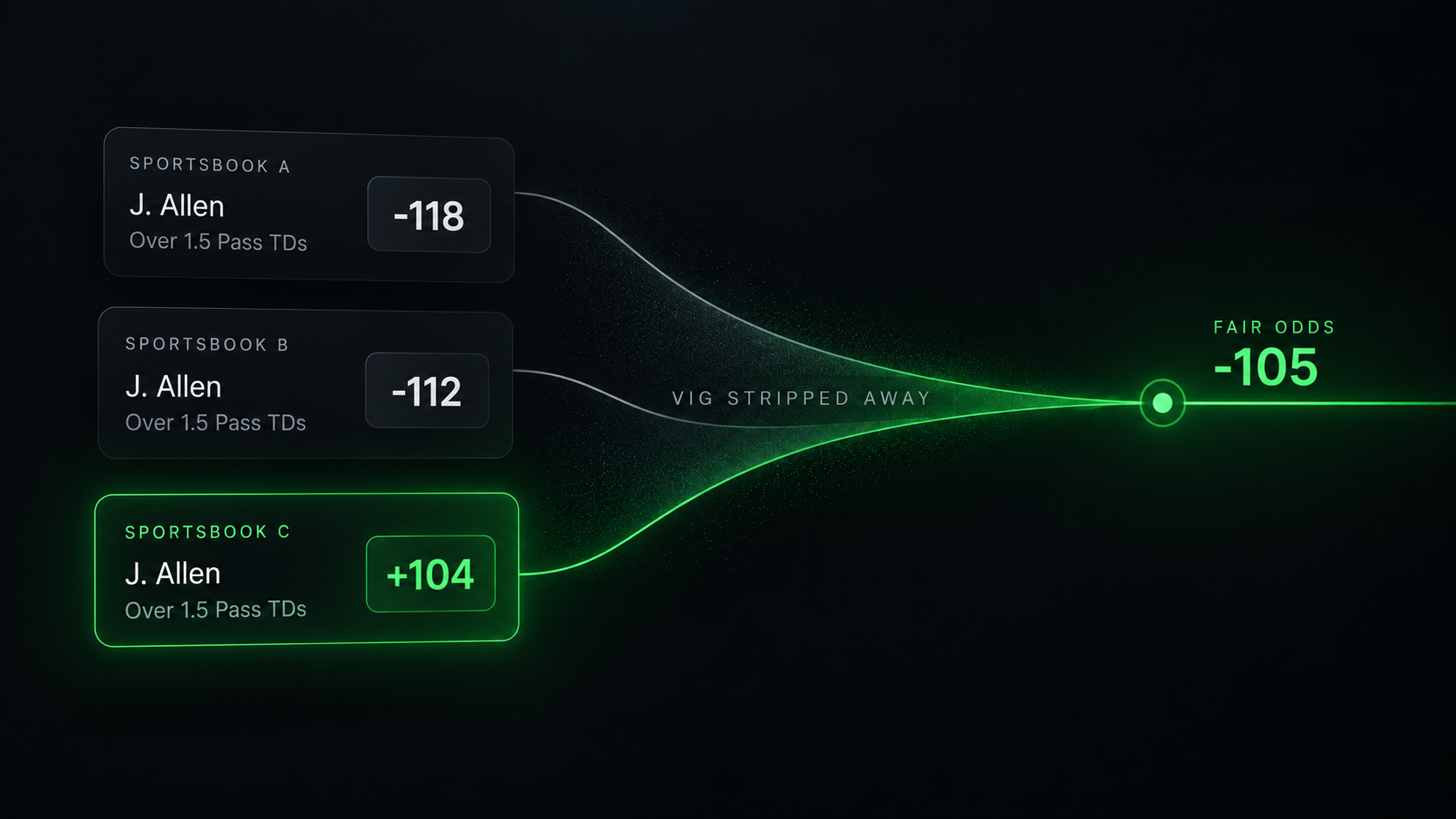
Every sportsbook bakes a margin into the line — the vig. If you look at raw odds and think "-110 means 52.4%," you're reading the book's cut as if it were probability. Do that long enough and you'll chase bets that look profitable and aren't.
The number on the screen is not the probability. It's the probability plus the house's rent.
So the second thing we built was the part that actually matters: removing the vig to estimate a true probability, then calculating expected value from that.
What we built, roughly in order
The promo solver came early and is still here. Connecticut books throw profit boosts and odds boosts constantly, and figuring out which leg combination maximizes a 50% profit boost is genuinely annoying arithmetic. We automated it.
The odds explorer grew out of the original table — filters, player props, market groups, best-price highlighting.
The Board came next: a live overview of what's actually moving, no setup required. Open it, see the market.
Devigging got serious. One method wasn't enough, so now there are three:
| Method | How it works | Best for |
|---|---|---|
| Consensus | Averages no-vig probabilities across your selected books | General use, deep markets |
| Pinnacle | Uses a single sharp book as the reference | Markets where sharps are priced |
| Weighted | Blends books by how sharp they are | Thin markets, player props |
The book list exploded. We started with three because that's what Connecticut had. Now we pull 30+ — US books, international books, sharp references like Pinnacle, Betfair, and Matchbook, and prediction-market exchanges like Kalshi, Polymarket, Novig, and ProphetX. The sharp books and exchanges aren't there for you to bet at. They're there to tell you what the line should be.
Bet tracking. You log a bet, we grade it — pulling historical odds to settle it automatically, including player props scored against real stat lines. Your record, your CLV, your actual results.
Paper bots. Strategies that bet fake money against real markets so we can see whether an approach holds up before anyone risks a dollar on it.
And along the way, the name changed. "Odds Slam" became Odds Crew, because it stopped being a tool and started being a thing you'd want other people in.
The principle underneath all of it
Every feature had to survive one question: does this tell the user something true, or something that feels good?
That's why the app shows you fair odds next to the book's odds instead of hiding the calculation. It's why there's a whole page explaining exactly how we compute expected value. It's why the paper bots exist — we'd rather find out a strategy is mediocre on fake money than sell it to you.
It's also why a lot of things got cut. A prettier number is easy. An honest one takes a devig pipeline, a sharp-book reference set, and a probability bucketing layer nobody sees.
Where this goes
The core is stable now. What's next is depth: better research data feeding the prop models, smarter alerts when a line you care about moves, and more of the Crew — sharing plays, tracking each other's results, arguing about them.
If you've been line shopping by hand, start with the Board. If you've been guessing whether your bets are actually good, start with bet tracking and give it a month of real data.
Either way — welcome to the crew.
New here? Read how we calculate EV before your next bet. It's ten minutes and it'll change how you read a line.